Fire in Paradise

I have a bunch of ideas of analyses I could do with public use data (Census or otherwise), that I may never have time to turn into complete papers. But with the help of AI, I realized I can at least do the analyses themselves. And then I can share via a blog post. That’s what I’m doing here.
Ever since the Camp Fire in Paradise, California, I have wanted to understand what happens when a disaster wipes out an entire town and whether that place can recover. I’ve written about this before, but now have updated and expanded on the analysis I started with Gabriela Lahera Vázquez, going through 2023 (five years after the 2018 fire) and adding some additional analysis.
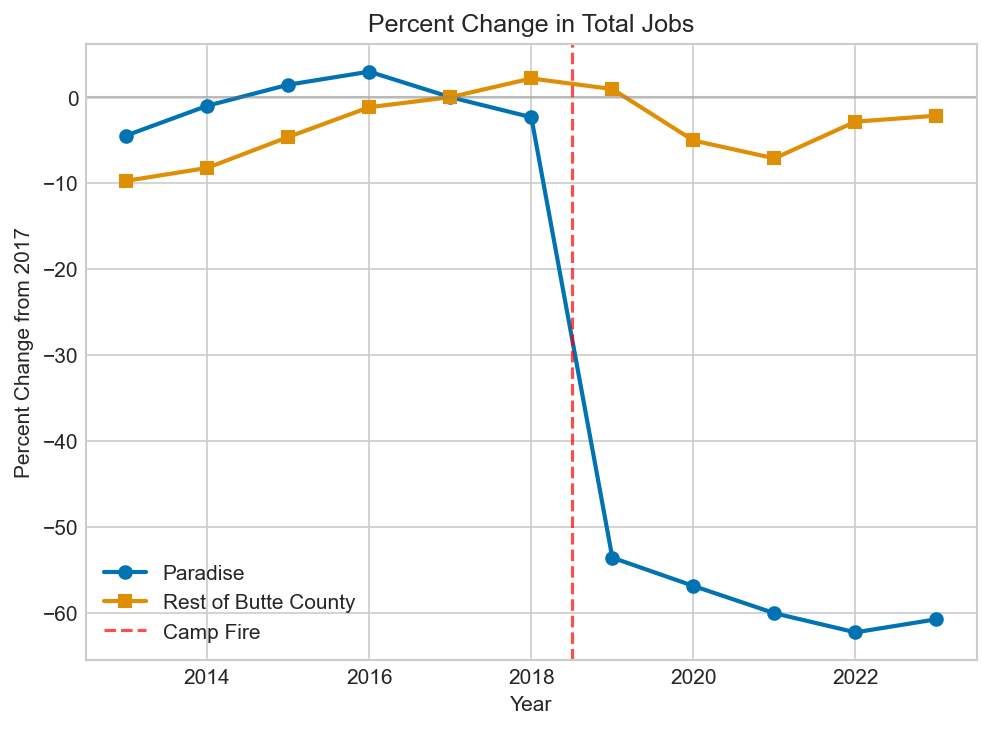
Paradise, California is located in Butte County. So, to start I used LODES data from 2013 to 2023 to identify the Census tracts in Paradise, versus those in the rest of Butte County to look at all how the total number of jobs evolved. This is normalized to zero in 2017, and we can see the huge job loss in Paradise compared to the rest of Butte County. And there is not a notable recovery.
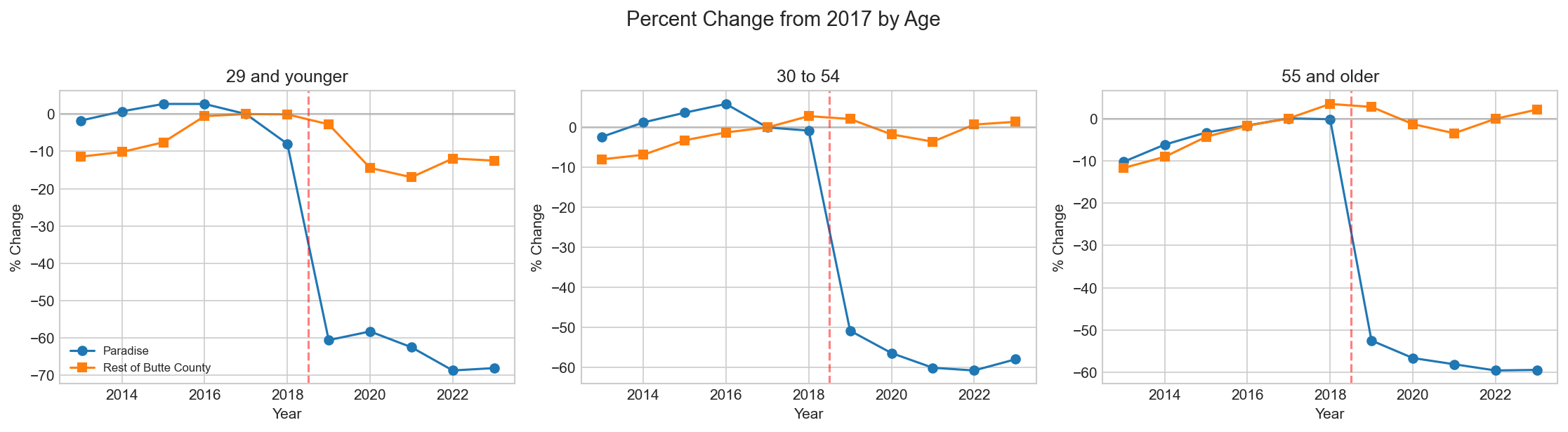
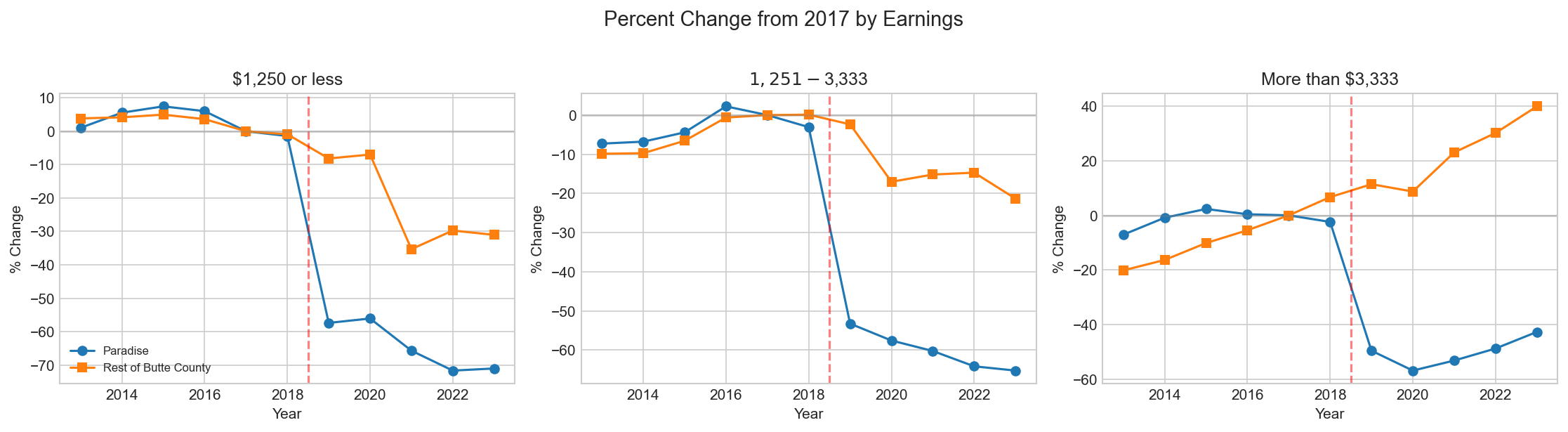
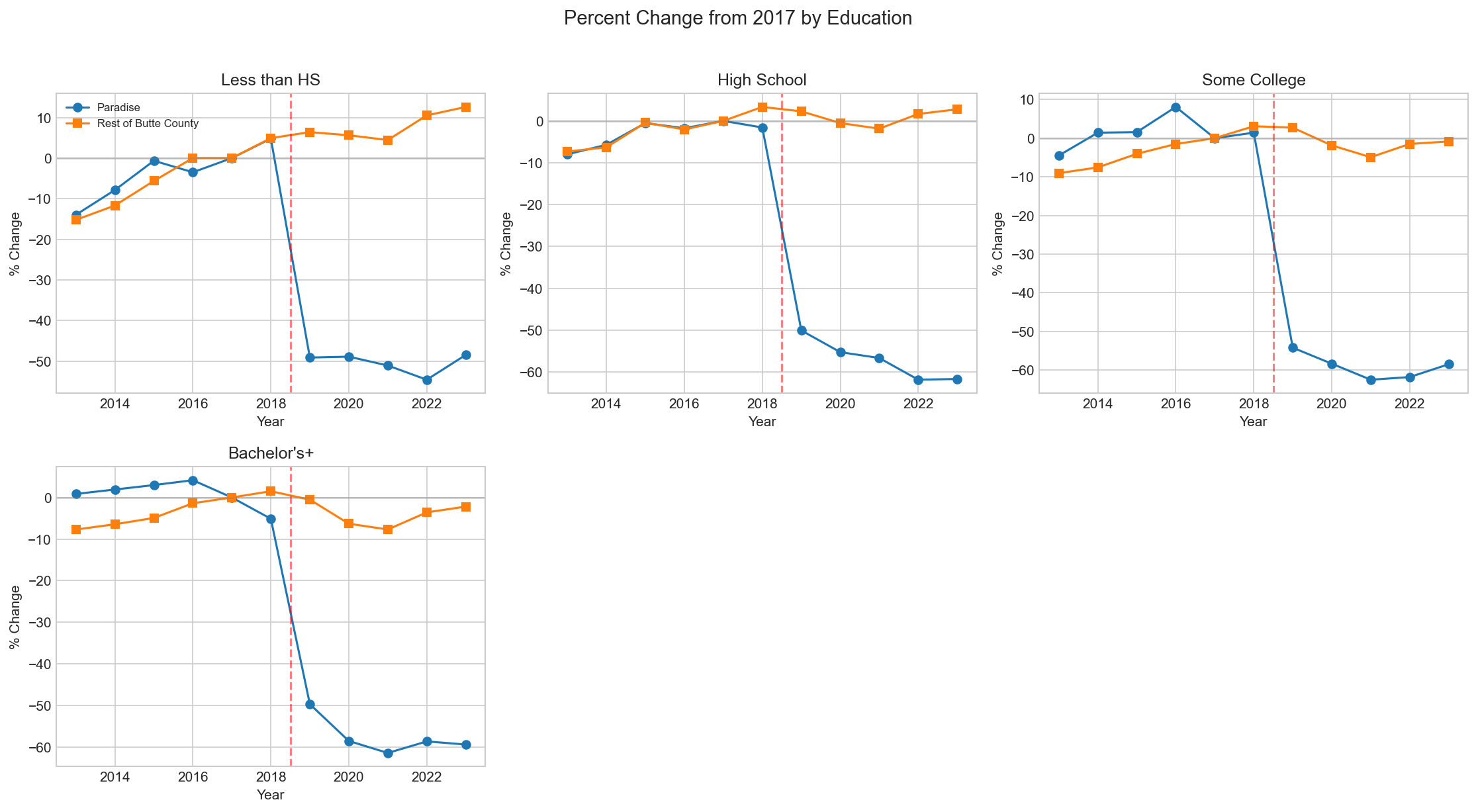
The job losses were widespread. You see it by age, income level, and education level.
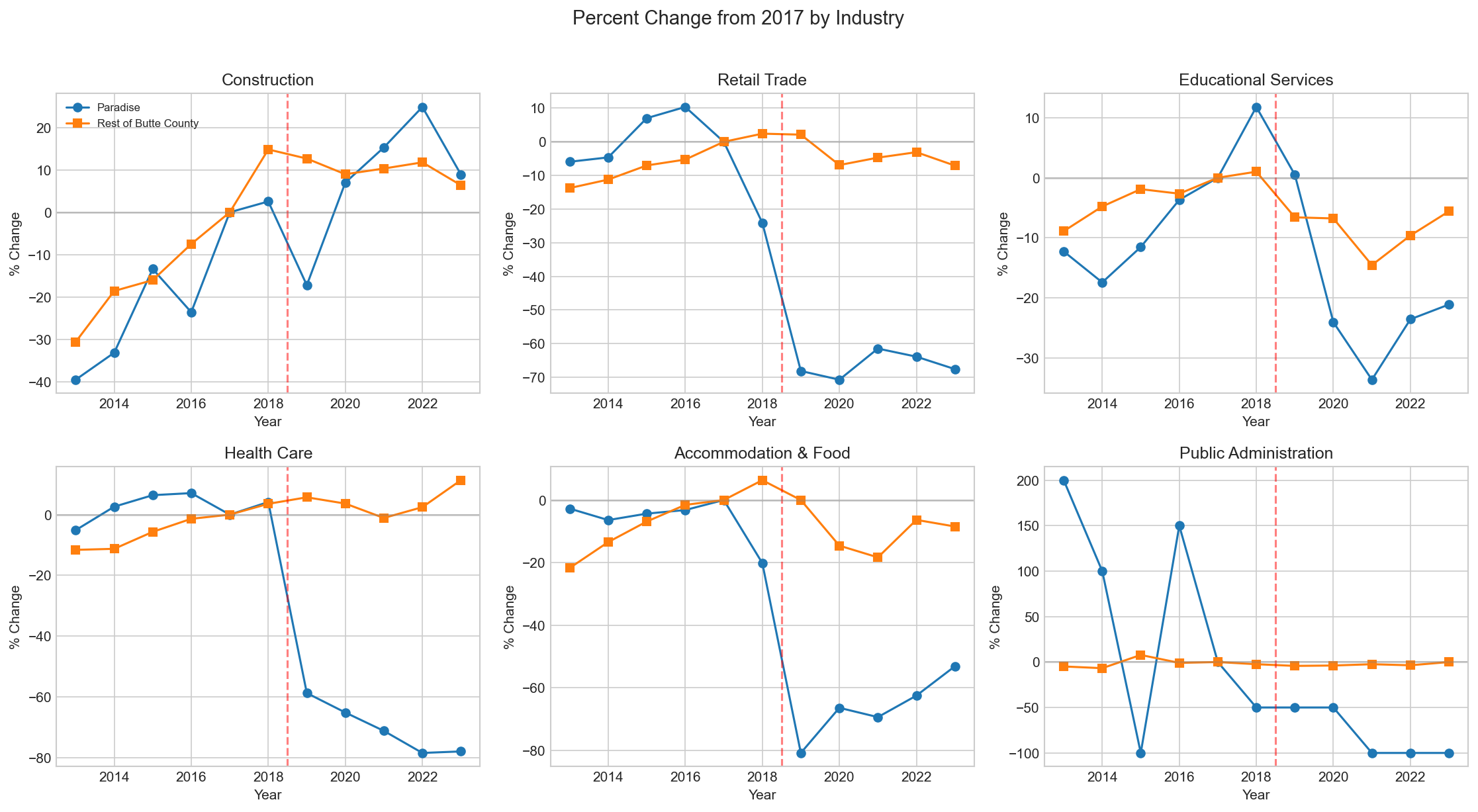
We also see drops across most industry categories. Retail trade and accommodation drop in 2018. The fire was in November 2018, so it is surprising to see the early drop, and may be some data noise. Health care was a big industry in Paradise. There was a large hospital there. So the drop in health care jobs without a recovery is particularly painful for the town. Construction jobs do not decrease. Disasters require a lot of construction.
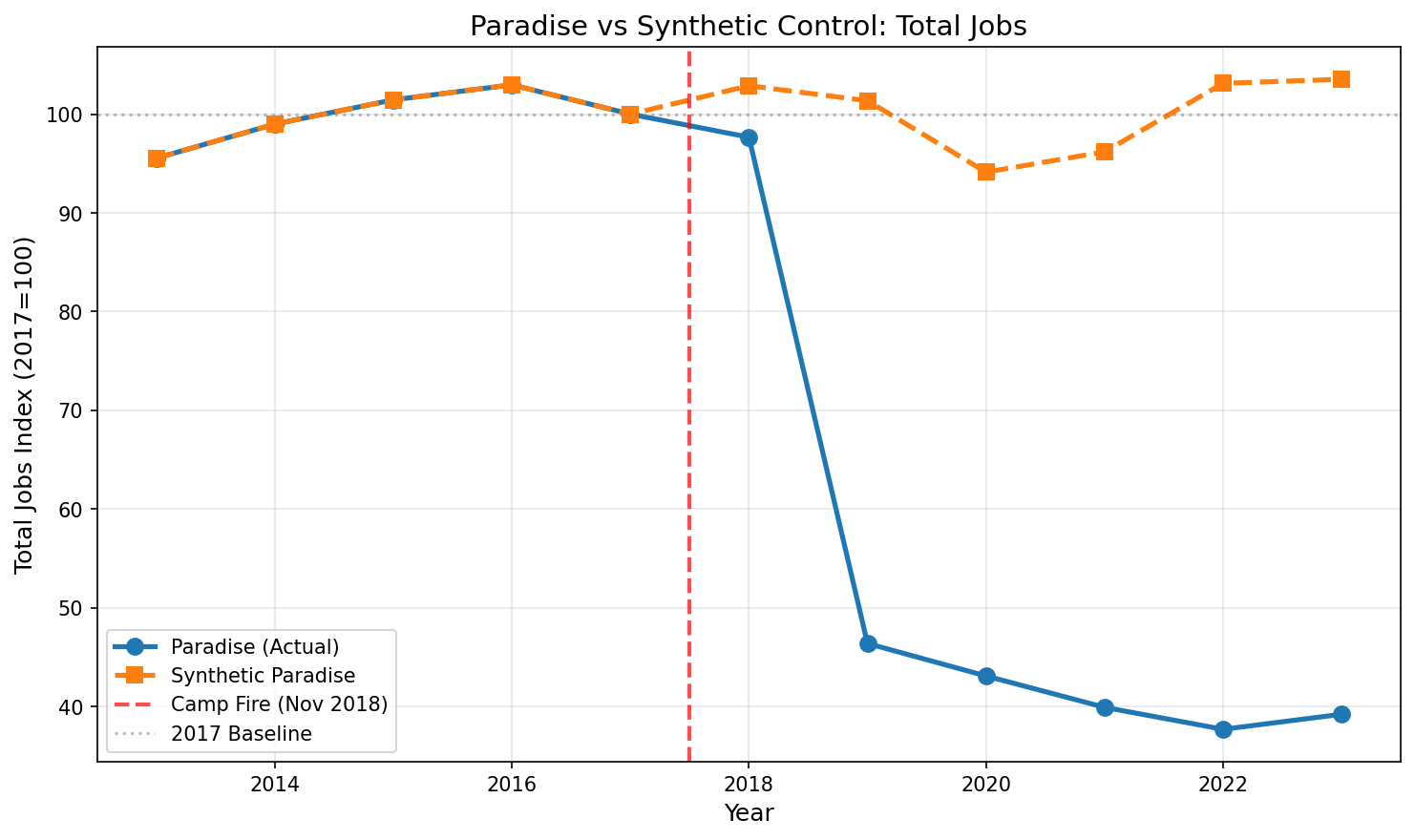
Butte County is probably not the best comparison, since a lot of the former residents of Paradise may have moved to elsewhere in Butte County. In fact, this reporting indicates that the homeless crisis, which was already bad in the area, became even worse once the fire displaced a whole town’s worth of residents. So, I did a synthetic control analysis to understand the magnitude of losses in the Paradise tracts relative to similar tracts elsewhere in California, excluding all of the other tracts in Butte County.
I ran a synthetic control comparing the tracts in Paradise to other tracts in California, outside of Butte county. Employment is about 50% lower in Paradise after the fire relative to the synthetic control, and job losses are persistent. The comparison tracts experienced job losses in 2020 and 2021, around the pandemic, but these losses are dwarfed by the losses in Paradise.
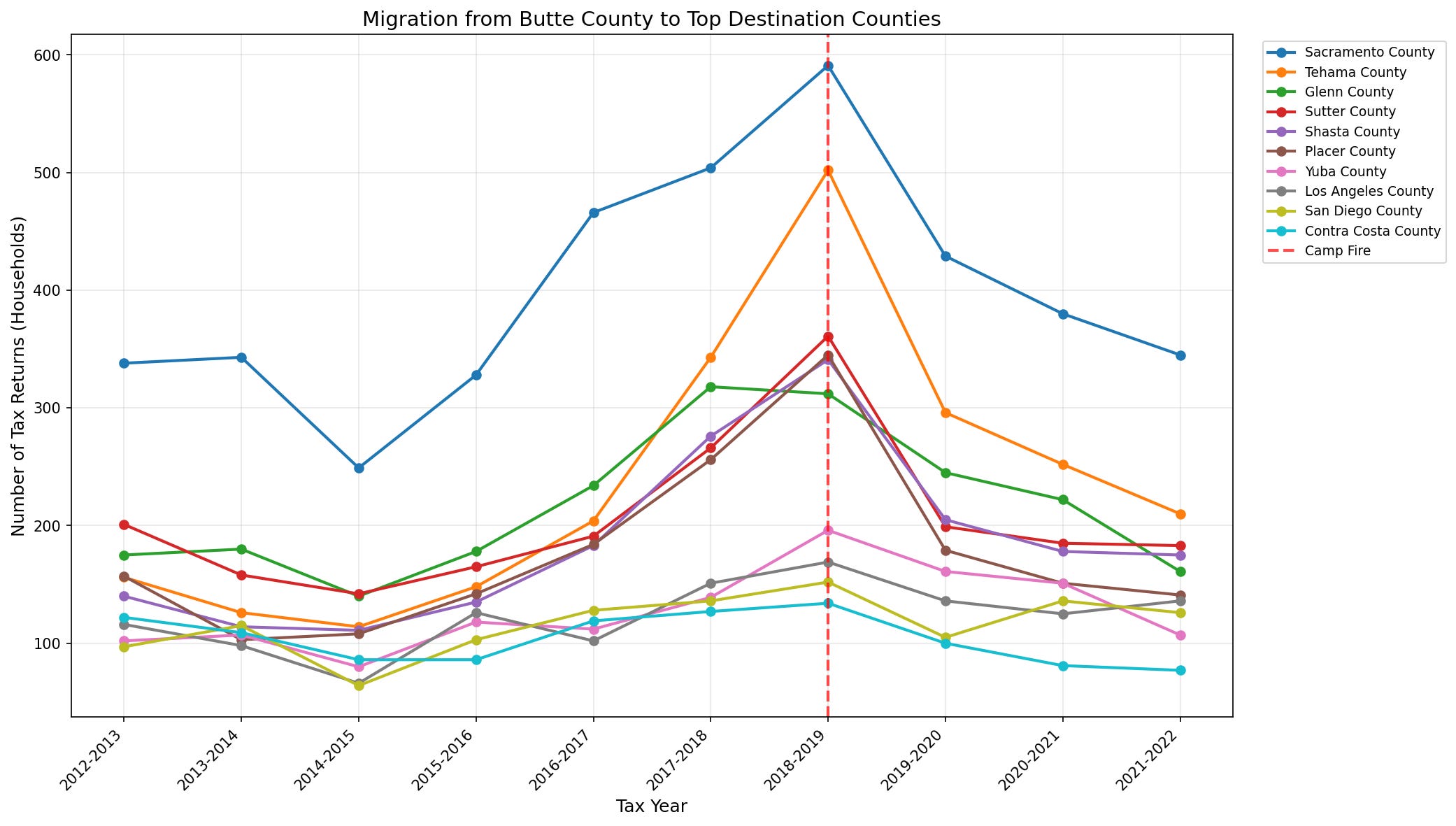
Where did all of these people go? Many, I’m sure, moved to Chico and elsewhere in the county, but the IRS Statistics of Income migration data shows that many of them moved elsewhere in California. There was growth in migration to some of the largest destinations even before the fire, but a big spike in 2018-2019 to Sacramento, Tehama (the county next-door to Butte) and other local counties. Most of the Paradise residents seem to be staying in northern California. There is not much of a spike to the large southern counties like Los Angeles and San Diego and not much movement to the Bay Area either. Instead those that move to a city are moving to the cheaper option of Sacramento.
There is more you could do with microdata, rather than aggregate data, to actually understand how those who were displaced by the fire fared. Biswas, Hossain, and Zink have made some progress looking at mortgage data, but a lot more could be done.
The Paradise fire affected a rural, mostly white population. The fire in Altadena displaced an urban/suburban mostly Black population. Not enough time has passed since that fire (in 2025) to understand the effects, but comparing the two locations and the trajectories of the former residents could help us understand how the people and places affected by wildfires can be supported and how they recover.
The GitHub repository for this analysis is here, for anyone curious about the analysis or data sources: https://github.com/dismalscientist86/ParadiseFire/